
The field is still damp from the morning marine layer when the first students step outside. Cones in brilliant orange and neon green stretch across the grass. Sapphire hoops glisten in the sunlight. Scarlet foam balls rest in baskets like treasures waiting to be discovered. Parachutes ripple in the breeze, catching young eyes before a single direction is given. The outdoor classroom is alive—open sky overhead, birds tracing arcs above, the scent of eucalyptus in the air. In this space, physical education does not feel separate from learning; it feels like its most natural expression.
As the lesson begins, bodies become storytellers. A prompt—“Move like the wind before a storm”—turns into a symphony of motion. Students swirl, sprint, balance, and pause, negotiating space without words. Laughter rises as they experiment with speed and strength. They feel grass cushion their landings, dirt ground their pivots, wood chips crunch beneath their feet. Breath deepens in the open air. Shoulders relax. Eyes brighten. Connection forms—between classmates, and between body and environment.
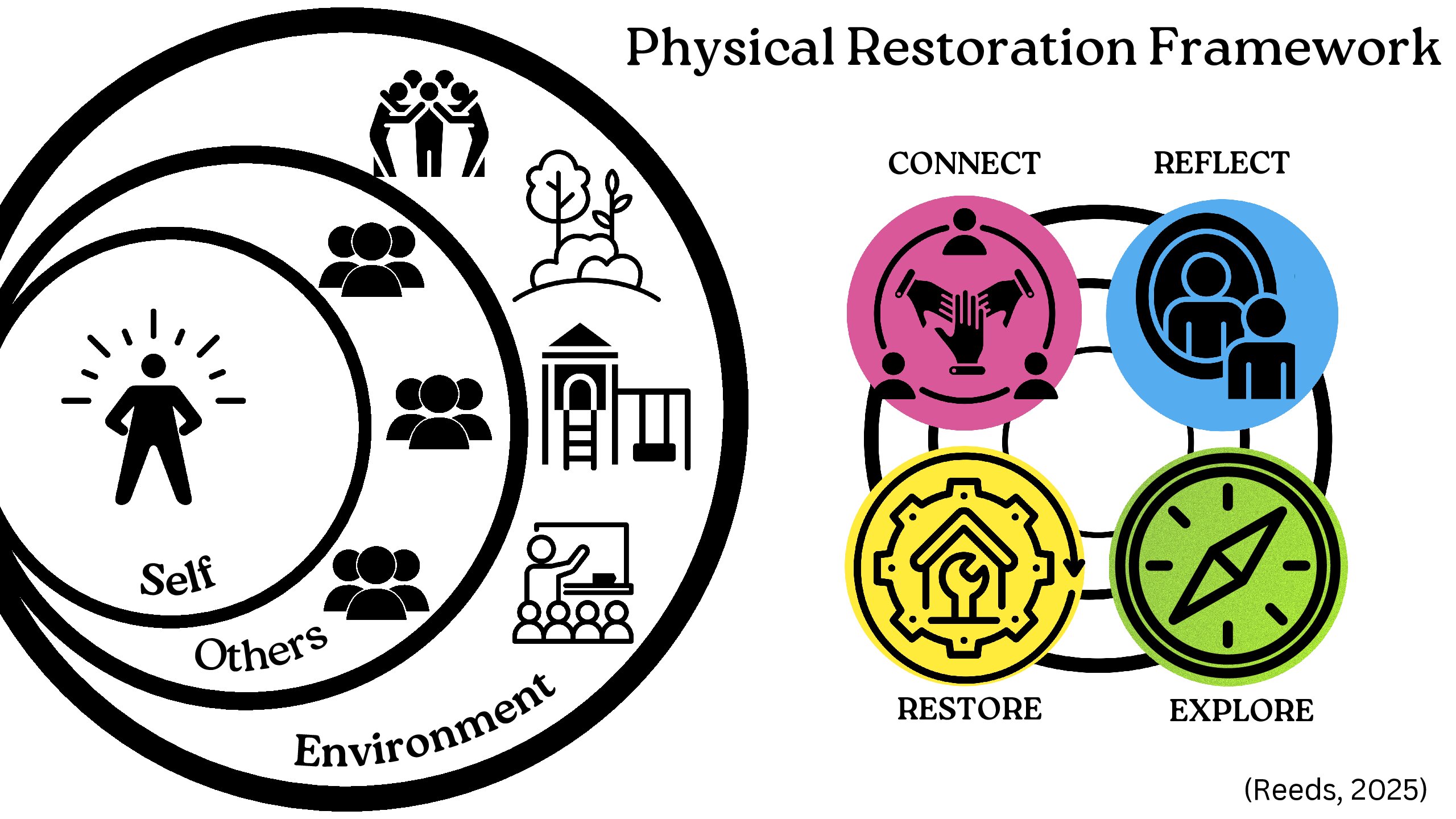
This is the first pillar of the Physical Restoration Framework: Connect. Physical education naturally cultivates connection—to self, to others, and to the outdoor space that holds the learning.
Midway through the lesson, movement slows. Students gather in a circle on the grass, breathing elevated but steady. One hand rests on the chest, one on the abdomen.
“Notice your breath. What helped you keep moving when it felt challenging?”
The shift from motion to meaning is subtle but powerful. Students identify how they adjusted balance, speed, or pathways. They notice increased heart rate and muscle fatigue. They describe how grass feels different from dirt or sand. They reflect on cooperation and encouragement. In doing so, they engage core elementary physical education standards: movement concepts, self-monitoring of fitness, responsible behavior, and valuing physical activity.
Reflection remains embodied. Students take a brief sensory walk, noticing sound, surface, and air. They turn to partners to share strategies. They count their pulse and observe recovery. Outdoors, reflection deepens ecological awareness: Surfaces influence force; wind alters trajectory; temperature affects endurance. The environment becomes a co-teacher.
This is Reflect—the second pillar—where awareness strengthens physical literacy and supports nervous system regulation.
Then the lesson widens again.
“Now that you’ve noticed your breath and your body, let’s explore.”
Students rotate through outdoor stations. On grass, they investigate jumping and landing mechanics. On a dirt path, they adapt locomotor patterns to uneven terrain. In sand or wood chips, they test balance and center of gravity. Under a tree’s shade, they adjust throwing and catching as wind shifts the ball’s path.
Exploration is guided inquiry. Students are not simply performing skills; they are investigating them. They ask: How does this surface change my speed? What muscles work harder here? How must I adjust? Standard 1 (motor skills), Standard 2 (movement concepts), and Standard 3 (fitness principles) unfold in real time. Adaptability, resilience, and problem-solving emerge naturally.
This is Explore—movement as discovery within the living landscape.
Finally, the lesson closes not in exhaustion but in renewal.
Students return to the circle. Some sit quietly in the grass; others lie back and watch clouds drift. Breathing slows.
Restoration unfolds in three layers:
Restore Self: Students notice their pulse settle and identify where they feel calm or strong, supporting regulation and emotional grounding.
Restore Others: They offer appreciation—recognizing encouragement, teamwork, and shared effort—deepening belonging and psychological safety.
Restore Environment: They gather equipment mindfully, check the field, and leave the space better than they found it. Stewardship becomes a habit.
This is Restore—the culmination of connection, awareness, and exploration.
When students Connect with one another and with the natural world,
When they Reflect on their bodies and their behaviors,
When they Explore movement across varied terrains and elements,
And when they Restore themselves, their relationships, and their environment— physical education becomes restoration in motion.
The Physical Restoration Framework reveals what outdoor learning advocates have long understood: Children thrive in relationship with the natural world. In the open air of a field, under shifting skies, movement becomes a vehicle for resilience, ecological awareness, and human connection.
Outdoor physical education is not an extension of the classroom—it is its most embodied expression.
Outdoor learning does not require reinvention. It requires recognition.
The field, the blacktop, the school garden, the patch of shade beside a building—these are not peripheral spaces. They are untapped classrooms. Physical education already holds the structure, standards, and expertise to activate them with purpose.
If we believe children deserve to feel strong in their bodies, steady in their emotions, connected to one another, and rooted in the natural world, then we must design systems that make outdoor movement non-negotiable—not occasional, not enrichment, but essential.
Imagine schools where every child steps outside daily. Where movement is not withheld but woven into learning. Where students understand how wind changes a throw, how grass absorbs impact, how breath can calm the mind. Where they leave each lesson not depleted but restored.
This is not aspirational. It is actionable.
Advocate for protected outdoor instructional time.
Partner across disciplines to extend learning beyond four walls.
Invest in physical education as a cornerstone of whole-child development. Design campuses that invite movement rather than restrict it.
When we intentionally connect, reflect, explore, and restore in outdoor physical education, we cultivate more than fitness—we cultivate resilience, stewardship, and belonging.
The invitation is simple: Open the doors to the “breathing room.”
Let children feel the ground beneath their feet.
Let them breathe deeply.
Let them move.
Because when we bring physical education outdoors with purpose, we do not just change a lesson—we change a generation.

4 Responses
Wow, simply awesome! We are all so very proud of you and all of your accomplishments, well done!
I have had the opportunity to listen to a presentation given by Dr. Reeds. She is equally dynamic in person as she is in her written works. As an elementary general ed. and special ed. teacher, this article left me excited, uplifted and hopeful for the future of education and our youth. Her amazing protocol needs to be required reading and practice for all educators and parents. I look forward to following more of her publications. Excellent piece!
Thank you so much for your incredibly kind and generous words. Your reflection means a great deal to me, especially coming from an educator who serves in both general education and special education spaces. That perspective is so important.
One of the aspects of this framework that matters most to me is its potential to support students with diverse strengths, needs, and ways of being in the world. I have seen its impact in Unified Physical Education, where it can help cultivate meaningful connection among peers with and without disabilities in ways that are grounded in dignity, mutual respect, and an asset-based lens. So often, students with disabilities are viewed through a deficit perspective, when in reality they bring valuable insight, leadership, joy, resilience, and community-building strengths to shared learning spaces.
At its heart, this framework is about creating environments of psychological safety, authentic connection, and belonging, where every young person feels seen, valued, and able to participate as their full self. I am deeply encouraged to know that this message resonated with you, and I am grateful for educators like you who help bring these ideas to life in ways that can transform school communities for all students.
The message we all need to hear as you provide learning away from screens and connecting on a physical/emotional level with the outdoors. Simply the message needed for all educators and parents. Impressive on every level.