
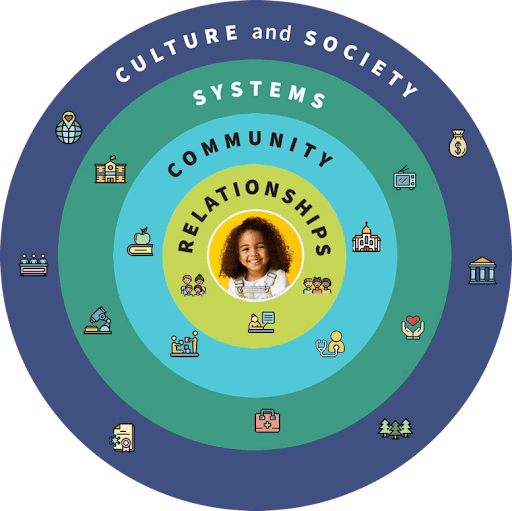
There’s a well-respected model in child development called the ecological systems theory (Bronfenbrenner 1979). It posits that child development is best understood in the context of the entire ecosystem in which children grow up and the forces that shape it. When someone says “ecology,” a lot of people probably think of natural ecosystems, like forests or the ocean. Those are types of ecologies—ecology in general is the interaction between organisms and their environment.
Because we have insulated ourselves from many of the natural forces that shape our environment, a child’s ecology is mostly determined by the systems and relationships in their lives: parents and caregivers; teachers and doctors; schools and social services; parks, sewers, and roads; and even elected officials. Thus, a child’s developmental “ecology” is all of the relationships, systems, opportunities, and barriers surrounding a child as they grow.
The Digital World Has Become Part of Childhood
The ecological model of development was recently updated by Phillip Fisher and Joan Lombardi at Stanford University to include digital environments as a new component of the ecosystem. Our relationships and experience with the world are increasingly mediated through technology. We communicate via text and social media, get our news online, teach our children with devices, and many of us now use AI for even menial tasks. Looking at technology use through an ecological lens helps us understand the multilevel pressures driving youth—and all of us, frankly—towards unhealthy technology use and away from healthy behaviors.
The intrusion of the digital world into children’s ecology has sparked considerable fervor and debate. It happened incredibly fast and is only accelerating. A generation that grew up without the internet is raising children in a world filled with smartphones and AI chatbots. While there’s an overarching drive to reduce children and teens’ screen time, there is also growing recognition that screen time alone is only part of the story.
The Problem Isn’t Just Screen Time

This is something digital media researchers have known for a while now. Screen time is harmful when it’s inappropriate—that could be too much screen time, harmful content or interactions online, or the displacement of healthier or more developmentally important alternatives. Not all harmful uses of screens include excessive screen time, and high amounts of screen time aren’t always bad. In infants and young children, screen time alone can be detrimental because they rely on interactions with parents and their environment to learn. As kids get older, the problem isn’t necessarily total screen time but the who, what, when, where, and why of screen use and its relation to necessary non-screen activities, such as sleep and face-to-face interaction.
The debate over how best to address this covers everything from outright bans to light-touch guidelines. Rarely, if ever, does it branch out of the digital realm. Yet if the debate stops with screens, we are limiting ourselves. We live in a digitally augmented world, not a purely digital world, and solutions must reflect this.
The ecological systems theory offers some solutions. It demands we reshape children’s ecology, both physical and digital. That’s a daunting task. Thankfully, other fields have laid some groundwork.
What We Can Learn from Addiction Science
In a past life, I was an addiction neuroscientist, and I think we can draw major lessons from our collective successes and failures in this area. Historically, we’ve tried to prevent the use of some addictive substances to mitigate societal problems. That has worked to some degree but not as well as people hoped. For instance, Congress tried eliminating alcohol consumption in the early twentieth century by ratifying the Eighteenth Amendment and passing the Volstead Act. To support this, the US government went as far as poisoning batches of alcohol to discourage use. But, people kept drinking and selling alcohol, despite the risk of arrest, illness, and even death (Burton 2016, Hall 2010). The debate over the effects of prohibition-era policies is more nuanced than portrayed here, but regardless they faced tremendous resistance and produced unintended consequences. The opposition was so strong that Congress eventually repealed the Eighteenth Amendment through passage of the Twenty-First Amendment.
Policies relying solely on restrictions to reduce drug and alcohol use often have limited success and can carry significant financial and personal costs. Clinical approaches that rely on personal responsibility and abstinence have likewise faced limitations. Consequently, addiction scholars have put greater emphasis on the systems and environments that drive substance use, in addition to the relationship an individual has with a drug.
For instance, research has found that punitive measures, like incarceration, are ineffective at ameliorating addiction to some drugs. In contrast, interventions that reward people for abstaining, build coping skills, strengthen social, familial, recreational, and vocational reinforcements, and build healthy habits work remarkably well (De Crescenzo et al. 2018, Ersche et al. 2016). These approaches work because they reshape the environment the patient lives in and teach the patient how to engage with it. They increase access to healthy alternatives, address unmet needs, teach patients better habits, and, to the greatest extent possible, change the environment to support a healthier lifestyle.
Children Need Real-World Alternatives
Implied in all of this is the reality that lasting, positive behavioral change requires safe, healthy options and the ability to utilize them. We can change the online environment all we want, even ban children from parts of it, but without viable offline alternatives, young people are likely to be drawn back online and into the pockets of the internet and patterns of use we wish they’d avoid.

We have so efficiently insulated ourselves from natural ecology that we’ve largely removed those viable alternatives to screens, particularly for children living in cities. We must intentionally build them back in, and we must teach young people how to use those spaces to meet their need for learning, socialization, support, and even entertainment.
Building a Healthier Childhood
At Children and Screens, we are working to help children lead healthy lives in this new, digitally augmented world. A lot of this involves reforming online spaces to support healthy development and teaching families and educators to use technology in healthier, safer ways. But we know that healthy lives for children require safe offline spaces for kids to occupy and the ability to access those spaces. Just as screen time displaces healthy behaviors, like active time outside, when kids spend time outdoors, they inherently spend less time on screens and gain the opportunity to develop a more balanced lifestyle.

The California Campaign for Outdoor Learning offers a complementary approach to digital media policies. Statewide outdoor learning would affect nearly every child in California, offering outdoor spaces to kids for hours a day, teaching kids the value of these spaces during critical developmental periods, and potentially carrying unique benefits beyond physical activity alone (Bao et al. 2021, Dettweiler et al. 2023), all while meeting children’s education needs. The same outdoor spaces can be used across ages and demographics for play and community building, making outdoor education a uniquely scalable approach more easily adapted to the specific needs of different developmental periods and across demographics (Bao et al. 2021, Craig et al. 2022, Zhu et al. 2024). Importantly, it reestablishes the natural world as part of every child’s developmental ecology, taking a major step towards reshaping the ecology of childhood.
That’s why Children and Screens has joined the litany of voices supporting the California Campaign for Outdoor Learning. The reforms can’t stop at schools, but they are a great start. We, the adults, create the ecology children currently grow up in, and it is within our power to change it. We should treat that with the magnitude it deserves.
References:
Bao, Yu, Ming Gao, Dan Luo, and Xudan Zhou. 2021. “Effects of Children’s Outdoor Physical Activity in the Urban Neighborhood Activity Space Environment.” Front Public Health 9: 631492. https://doi.org/10.3389/fpubh.2021.631492.
Bronfenbrenner, Urie. 1979. The Ecology of Human Development: Experiments by Nature and Design. Harvard University Press.
Burton, Tara Isabella. 2016. “The Darker Side of Prohibition.” JSTOR Daily, January 1. https://daily.jstor.org/darker-side-prohibition/.
Craig, Danielle, Nazia Afrin Trina, Muntazar Monsur, et al. 2024. “Effective Nature-Based Outdoor Play and Learning Environments for below-3 Children: A Literature-Based Summary.” International Journal of Environmental Research and Public Health 21 (9): 1247. https://doi.org/10.3390/ijerph21091247?urlappend=%3Futm_source%3Dresearchgate.net%26utm_medium%3Darticle.
De Crescenzo, Franco, Marco Ciabattini, Gian Loreto D’Alò, et al. 2018 “Comparative efficacy and acceptability of psychosocial interventions for individuals with cocaine and amphetamine addiction: A systematic review and network meta-analysis.” PLOS Medicine 15 (12): e1002715. https://doi.org/10.1371/journal.pmed.1002715.
Dettweiler, Ulrich, Martin Gerchen, Christoph Mall, Perikles Simon, and Peter Kirsch. 2023. “Choice matters: Pupils’ stress regulation, brain development and brain function in an outdoor education project.” British Journal of Educational Psychology 93 (Suppl. 1): 152–173. https://doi.org/10.1111/bjep.12528.
Fisher, Philip A. and Joan Lombardi. 2025. “The New Ecology of Early Childhood: Revisiting Bronfenbrenner’s Theory in the Context of Contemporary Challenges and Opportunities” (Working Paper). Stanford Center on Early Childhood, Stanford University. https://earlychildhood.stanford.edu/new-ecology-early-childhood-revisiting-bronfenbrenners-theory-context-contemporary-challenges-and.
Hall, Wayne. 2010. “What are the policy lessons of National Alcohol Prohibition in the United States, 1920–1933?” Addiction 105: 1164–1173. https://doi.org/10.1111/j.1360-0443.2010.02926.x.
Ersche, Karen D., Claire M. Gillan, P. Simon Jones, et al. 2016. “Carrots and sticks fail to change behavior in cocaine addiction.” Science 352 (6292): 1468–71. https://doi.org/10.1126/science.aaf3700.
Paulus, Martin P., and Jennifer L. Stewart. (2020). “Neurobiology, Clinical Presentation, and Treatment of Methamphetamine Use Disorder: A Review.” JAMA Psychiatry 77 (9): 959–966. https://doi.org/10.1001/jamapsychiatry.2020.0246.
Zhu, Weijia, Xun Luo, André Oliveira Werneck, et al. 2024.. “Nature and success: Outdoor play is linked to school readiness.” Complementary Therapies in Clinical Practice 57: 101895. https://doi.org/10.1016/j.ctcp.2024.101895.

One Response
Is there a “key” labeling the icons used in the chart? Graphic courtesy of Children and Screens: Institute of Digital Media and Child Development