
(This article is the fourth in a series featuring the formation and progress of the coalition carrying out the California Campaign for Outdoor Learning. It is also the first in a new series exploring the connection between outdoor learning and the movement to reduce children’s screen time. Here are articles #1, #2, and #3. Want to get involved? Contact cstrang@berkeley.edu.)
A few years ago, “The Water of Systems Change,” an article by John Kania, Mark Kramer, and Peter Senge, made its way through the social change and equity and justice communities. It starts out like a-guy-walks-into-a-bar joke: “A fish is swimming along one day when another fish comes up and says, ‘Hey, how’s the water?’ The first fish stares back . . . and says, ‘What’s water?’” When I first read the article, I was particularly drawn to the metaphor, as well as the message, since for most of my career I have focused mostly on a small corner of science and environmental literacy—the corner that covers 71 percent of the planet.
Over the last three years, as the California Campaign for Outdoor Learning has taken shape, I’ve thought about that article often, and I thought I understood some of its implications for outdoor learning. Because today’s kids have grown up disconnected from nature, they aren’t even aware of their disconnection, just as they are not aware of the power of the connection they are missing. The ever-escalating ubiquitousness of screens and manipulative quality of social media in which they’ve been immersed since birth prevents our kids from knowing they are addicted (are fish addicted to water?). It also prevents them from recognizing that the resulting anxiety, depression, purposelessness, poor health, and physical harm they experience are neither normal nor inevitable. This “water” they swim in makes it difficult for young people to understand how constant digital engagement disconnects them from nature and that a connection to nature is the antidote to their addiction to screens.
My assumption has been that, even if we seem nostalgic, out of touch, or just old (OK, I’m a little of all three), it’s our job as adults—who still remember playing outside until dark and our parents not knowing where we were—to change the water that our kids are swimming in. Even if they get mad about having the pool drained.
I might have been wrong. There is a backlash building, maybe a tsunami that is just starting to push up against a shallow bottom. And it’s not coming only from fly fishers who can’t get their kids to go for a hike, teachers who can’t get their students to stop scrolling in class, and angel parents who have lost a child to suicide. The backlash does include “us” teachers, parents, pediatricians, mental health researchers, legislators, environmental justice advocates, and attorneys general but also, notably, kids. A lot of them. There are some signals that, just maybe, as The Who declared in 1965 (does this seem nostalgic and old?), “The Kids Are Alright.”
An organization called Crisis Text Line communicates via text with teens experiencing a mental health crisis to help them navigate their immediate situation and then make a plan to deal with similar crises in the future by identifying specific resources that help them cope with mental health distress. The organization partnered with a research group, Common Good Labs, to analyze over eighty-seven thousand anonymized conversations that occurred from 2019 to 2022 and identify the resources that young people mentioned as helping them in times of distress (“What do young people in crisis need from their communities?”). This analysis revealed six resources that youth in crisis say they need from their communities to help them cope. Outdoor spaces and nature came in sixth (and is separated from the resources ranked fifth and fourth by only a small percentage):
· Opportunities for social connection (18 percent)
· Engagement in music, writing, visual and performing arts (16 percent)
· Mental health services (10 percent)
· Exercise and sports programs (8 percent)
· Books and audiobooks (6 percent)
· Outdoor spaces and nature (5 percent)
I find this compelling and full of potential, especially since the responses were unprompted. These kids had significantly decreased access to safe outdoor time and spaces compared to previous generations, and this study was conducted during the pandemic, when most kids had even less access to the outdoors. Imagine if outdoor time were routinely provided to children, and they didn’t have to think it up on their own. In most outdoor learning settings, the benefits of outdoor spaces and nature are almost always combined with enhanced opportunities for social connection and often with one or more of the other most commonly named resources. Outdoor learning, while important enough on its own, is a supercharger that amplifies other remedies. Our teens know this without having read the report.
Meanwhile, at UC Berkeley, in my hometown, college students have launched Project Reboot, an organization whose mission is to help young people “reset their tech habits, reclaim their time and regain their focus.” They throw phone-free parties—outdoors. They gather in Memorial Glade on campus to play volleyball or cornhole or sit on a blanket under a tree or by a creek next to handwritten signs that say, “RECONNECT. COME MAKE A NEW FRIEND.” They leave their phones at home or put them in bags at the check-in table. They talk about deleting apps, taking back their minds, how screen addiction has been their birthright, and how they don’t want to be known as “the anxious generation.”
An article in Berkeleyside about Project Reboot (“These UC Berkeley students are leading the fight against phones”) reports that 78 percent of surveyed students said their phone use “prevents them from thinking deeply, being creative, or engaging fully with ideas.” One student said that on her phone-free walk to the gathering, she “. . . was able to recognize there is life around me.” Project Reboot has a research advisory board that includes neuroscientists and a media psychologist.
In both of these examples, young people, age thirteen to twenty-five, see the water they are swimming in—the only water they’ve ever known. They don’t like it, they’re changing it, and they’re asking some adult experts for help along the way.
Over the last few years, adult experts have done a reasonable job of alerting young people and parents to the profound harms caused by excessive screen time and toxic social media. We even have a new vocabulary for it: doomscrolling, brain rot, clickbait, trendslop, and dopamine loop. Mental health and law enforcement experts have their own, older vocabulary for it: anxiety, depression, addiction, bullying, suicide, and sexual predation. Other adult experts, including advocacy groups, researchers, legislators, and state attorneys general, are doing their best to decrease the time young people spend in the digital world, to make it safer when they are there, and to hold tech and social media companies accountable through criminal and civil lawsuits when they put our children in harm’s way.
The adult experts have been slower, until recently, to work the other side of the equation. We have only just begun to provide our young people with what they are asking for on the Crisis Text Line and in Project Reboot: carrots, not sticks. They want their lives to be better, not just less worse. They are asking for engaging alternatives to screen time, especially outdoor alternatives that promote connection to nature.
Increasingly, this conversation is no longer just about reducing screen time. It is also about expanding opportunities for what will replace it: meaningful connection, movement, exploration, creativity, reflection, play, and time outdoors. Less screen time only matters if it opens the door to more green (and blue) time.
The problem is that nearly every kid has a phone, but not every kid has equitable access to safe, healthy, calming, and inspiring outdoor spaces. Our schools have the often-unrealized potential to tip that scale back into balance. California schools, with our temperate, mostly Mediterranean climate and our spectacular open spaces, can provide all our students, beginning with those most vulnerable and furthest from the opportunity, with regular, rich outdoor learning experiences. Imagine what’s possible on green schoolyards, walking field trips to nearby parks and open spaces, longer field trips to more remote areas, and in our network of public and private residential outdoor science schools. Great vision, but not much chance of becoming reality. Right?
Well, things are starting to shift. The California Campaign for Outdoor Learning has brought together a wide array of outdoor and environmental educators, along with pediatricians, mental health professionals, epidemiologists, neuroscientists, youth advocates, equity and justice experts, and digital safety organizations, such as Children and Screens and Common Sense Media. Though these fields have often operated separately, we are beginning to recognize how deeply interconnected they really are. Advocates for outdoor learning and advocates for healthier digital environments are increasingly asking the same questions: What do children need more of? What conditions best support healthy development? And how do we design learning environments that foster attention, belonging, curiosity, resilience, and well-being? Powerful synergy is emerging where, only a short time ago, there was only parallel play.
Those most concerned about the hazards of screen time and social media have an intuitive sense that time outdoors provides one of the most powerful incentives for kids to keep their phones in their pockets, something that a phone ban just can’t achieve. They need the deep expertise of the outdoor learning community to make the case for carefully designed, positive alternatives. Those most concerned about sedentary kids who never go, much less play, outside know intuitively that devices stand squarely in the way of nature connectedness and well-being. They need the deep expertise of neuroscientists, addiction researchers, and online safety advocates to make the case for the dangers of the digital status quo. Together they form a loud, passionate constituency, committed to the same outcomes, and able to communicate with equal force about what kids need less of and what they need more of.
In the coming months, the California Campaign for Outdoor Learning will be exploring these intersections more deeply with researchers, practitioners, youth leaders, and organizations working at the forefront of children’s digital well-being. We have much to learn from one another and even more to build together.
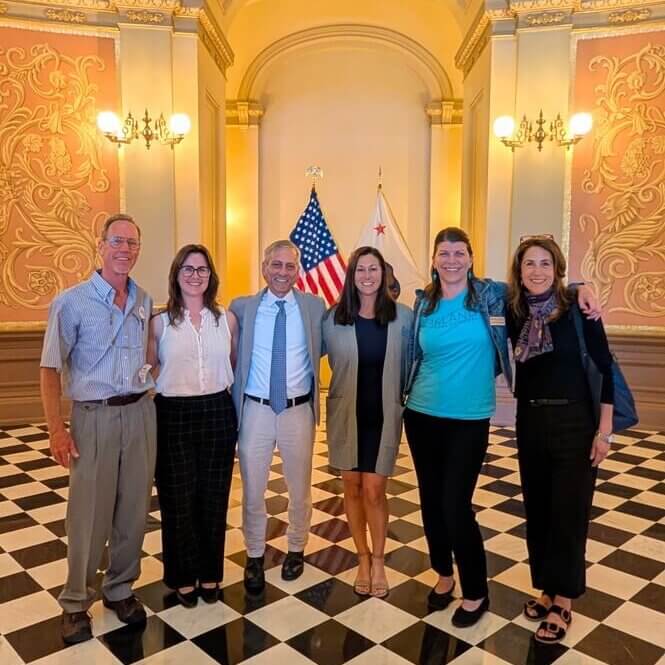
Working together in a statewide coalition, we have a bipartisan, bicameral bill in the pipeline, AB 2158, The Outdoor Learning and Environmental Literacy Act of 2026. Ten Strands is the sponsor. It is authored by Asm. Josh Hoover (R), the joint author is Asm. Josh Lowenthal (D), and the coauthors are Sen. Jesse Arreguín (D), Asm. Robert Garcia (D), Asm. Stephanie Nguyen (D), Asm. Rhodesia Ransom (D), and Asm. Kate Sanchez (R). On April 8, the bill sailed through the Assembly Education Committee on a joyful 9–0 vote. Then, on May 14, the Assembly Appropriations Committee passed the bill out of the suspense file and on to the floor for a vote by the full Assembly. We were told repeatedly that Appropriations would be our steepest hill to climb and that the suspense file is where bills like ours often go to die. We passed with no amendments and unanimous support from both parties. And then on May 27, the full Assembly passed our bill on a 61-0 vote. We pitched a perfect game all the way through the Assembly with not one whisper of opposition. Next, we will do it all over again in the Senate.
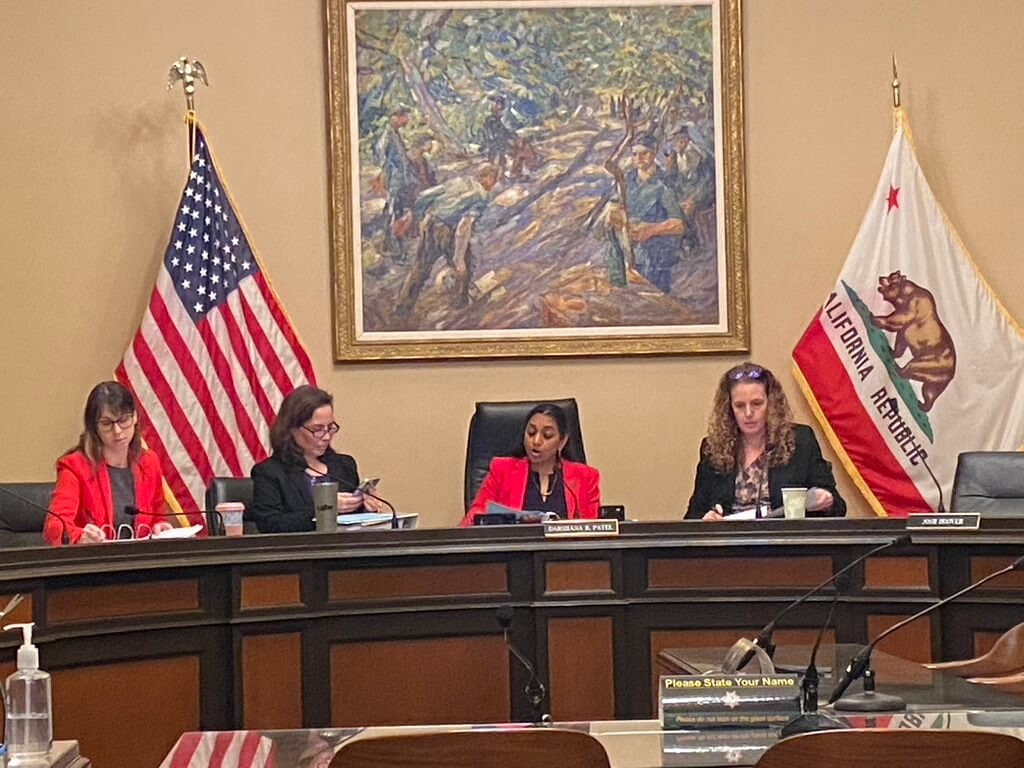
If AB 2158 makes it into law, it will establish outdoor learning as an important and recommended instructional strategy in the California Education Code; require the Department of Education to publish guidance to schools about best practices, safety, and partnering with community-based organizations to increase outdoor learning; and launch a statewide pilot that will allow us to gather impact evidence to inform recommendations to fund statewide expansion.
Working in partnership with the digital safety community and a wave of activist teens and young adults, it will be possible to find the funding necessary to make learning outdoors a significant part of every school year for every student. The money for statewide expansion might come from legislation, a ballot initiative, fines and penalties from lawsuits, a tax on tech and social media companies, or some combination of these.
And maybe never again will a kid stare back and say, “What’s water?”

5 Responses
Craig: Masterful reasoning and writing as usual. What a strong coalition to have created the conditions for the Assembly to have a clear view of the bipartisan support among their constituents for using outdoor learning as a crucial, healthy, and popular alternative to screen time!
Thanks, Will. Yes, the Coalition is so strong! There is so much support for this idea, so much enthusiasm, and not one person or organization has told us the time isn’t right or that we should wait in line behind other initiatives or that it’s a nice idea but not a high priority. It really feels like we can do this! Thanks to Ten Strands for the incredible backbone support!
This is very exciting and makes me hopeful. My tennis shoes have been on the ground teaching garden science and supporting a school farm space. One factor that often limits the outdoor ed effort is finding funding to employ dedicated people to manage spaces and guide student activities. We have found grants that help fund physical supplies but not salaries. The high turn over of volunteers (and lack of) leaves gaps in organization and wasted materials. My school district stresses outdoor education (the science) but not necessarily time outside. Teachers, especially as students get older, have so much academic material to cover that time for exploration is lost. As kids get older their ability and interest in being creative, being curious, diminishes as well.
Thank you for being a light!
Dawn B
Encinitas, CA
So glad I ran into your extraordinary article. I’ve shared it with many people who are working on similar issues in WA state and in my school district (Bellingham Public Schools). My educational career started at UCSC where we both led elephant seal tours; then I was an interpretive ranger in Glacier NP and then outdoor ed followed by classroom teaching (even brought MARE to Millbrae Middle School during Oceans Week – a long time ago). Just wanted you to know that your efforts continue to inspire outdoor learning opportunities far and wide!
Thanks so much, Lisa! I remember all our intersections in Santa Cruz, Millbrae and Bellingham! It has always been a pleasure when we cross paths. There are so many great things happening in WA—I hope we can contribute something to the conversation from down here in California!