At Ten Strands, we act as a catalyst, transforming systems to bring high-quality environmental education to all students. Our Q&A this month features Seaberry Nachbar, whose twenty-five years at the National Oceanic and Atmospheric Administration (NOAA) perfectly embody this mission. Seaberry developed and directs the powerful Bay Watershed Education and Training (B-WET) Program, a model for standards-aligned instruction that empowers teachers with the resources to move learning outside. She also created the grassroots Ocean Guardian School Program, giving students ownership of community stewardship projects. Dive in below to learn the origin story of these vital programs and why Seaberry believes collaboration is key to equitable access to nature.
Q: Please introduce yourself, including your name, organization, role, and affinity group identifiers you’d like to share.
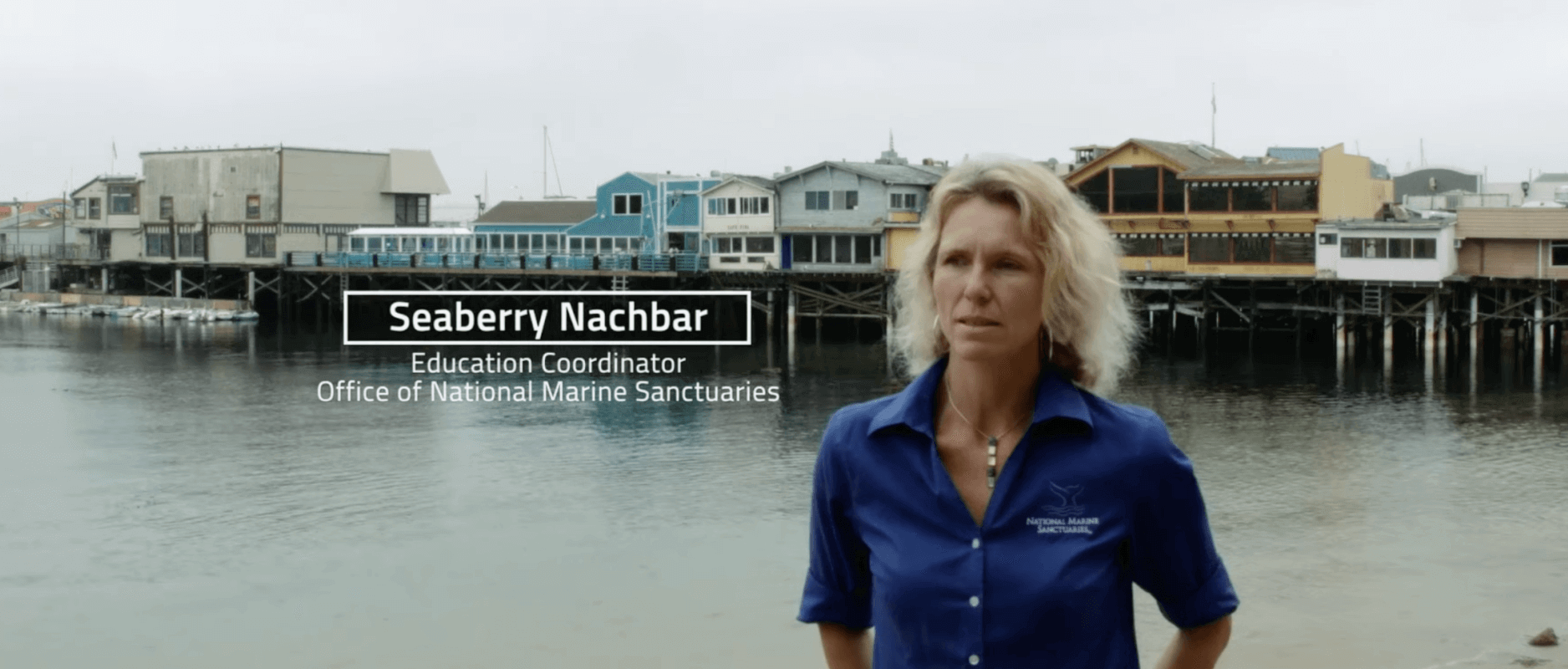
SN: My name is Seaberry Nachbar, and I am an education coordinator for the National Oceanic and Atmospheric Administration (NOAA) Office of National Marine Sanctuaries and manage a number of local, regional, and national NOAA education programs. I live in Monterey, California, with my family. I have three children, and I like to think I’ve raised them to be advocates and conservationists as they head out into the world. Being in nature fills my cup—it’s where I feel grounded and grateful for the beauty of this Earth.
Q: When did you start working at NOAA, and how did your role evolve?
SN: I started with NOAA in 2000, so I’ve been here about twenty-five years. Before that, I was a fisheries biologist with the US Fish and Wildlife Service in Maryland, working on the Chesapeake Bay. My job was to catch sturgeon, tag them, and track their movement. I loved being out on the water every day, but it was tough work—I often smelled like fish! And the pay wasn’t great, so I started looking for something more sustainable.
That’s when I heard about an opening at NOAA headquarters in Silver Spring. I remember going in for the interview—my first time ever buying pantyhose and professional shoes, because I just didn’t own any! Back then it was expected, though thankfully not anymore. I got the job as a science communicator, translating the work of the National Centers for Coastal Ocean Science into plain language for the public. It was a perfect mix of my science background and my love of environmental education.
After a year and a half, I moved to the NOAA Chesapeake Bay Office to coordinate and manage a new education program that was created to help students get outside and engage in meaningful environmental experiences. I wasn’t an expert, so I went out and asked teachers, students, and environmental educators what they needed. That process led to the creation of the Bay Watershed Education and Training (B-WET) program, which started in the Chesapeake Bay and has since grown to seven regions nationwide. And yes, I even came up with the acronym—it’s not a federal program without a good acronym!
Q: How does your work fit into the larger NOAA structure?
SN: Education is a small slice of NOAA, but we’re mighty. Sometimes it’s a hard sell in a science-driven agency to say that education is just as important as research—but it is. Through the NOAA Education Council, I get to work with colleagues across the agency who are deeply passionate about connecting young people with science.
What I love is that they don’t just show up and do the minimum. Everyone I work with pours their heart into it, going above and beyond because they believe in the power of education. Especially in challenging times, I’ve noticed how dedicated my colleagues are—they don’t just check boxes, they show up every day ready to make a difference.
Q: Who have you worked with most closely at NOAA?
SN: Education crosses every NOAA office, so I’ve had the chance to collaborate widely. It would be hard to single out one person, but I admire the trailblazers who pushed education beyond something “nice to have” and built programs backed by data and evaluation. They’ve shown measurable results—students more engaged, better attendance, improved academic standards. That proof has given education a stronger voice at the table alongside science and policy.
Q: Tell us the origin story of Bay Watershed Education and Training (B-WET).
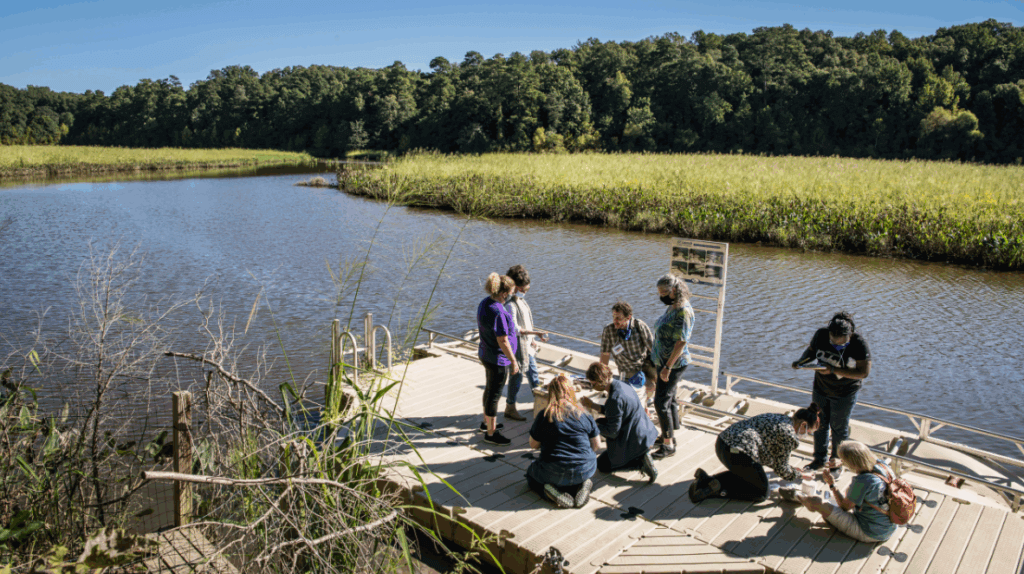
SN: The Chesapeake 2000 Agreement was clear: Every student in the watershed should have access to environmental education. From that, I worked with partners to design B-WET as a grant program rooted in the framework of the Meaningful Watershed Educational Experience.
That means multiple outdoor experiences throughout the year—not just a one-off field trip—where students study real issues like water quality or habitat health. They collect data, bring it back to the classroom, analyze it, and draw conclusions. Teachers get professional development to increase their confidence and capacity to bring their students outside to learn so it becomes part of the system, not just a special event.
Q: Tell us about the NOAA Ocean Guardian School program. Is it an offshoot of B-WET or completely separate?
SN: Ocean Guardian is a little different. While B-WET works from the top down with districts and administrators, Ocean Guardian is more grassroots. I was inspired by Australia’s Reef Guardian program, where schools take on projects to protect the Great Barrier Reef. When I brought the idea back, I knew US teachers would need funding and resources, so I set aside some of my California B-WET budget to start Ocean Guardian here.
Schools can apply for up to $4,000 to do a stewardship project on school campuses or in the community under one of five environmental pathways. The key is metrics—we require schools to track and report what they’ve accomplished. That way we can show, in real numbers, the impact these students are having on their communities and ecosystems.
Q: Can you share a favorite success story?
SN: One of my favorites is Gault Elementary in Santa Cruz. The students partnered with a nonprofit to restore the beach dunes. Week after week, these third, fourth, and fifth graders walked a mile to the dunes to pull out invasive ice plants and replace them with native plants.
Over five years, they completely transformed the ecosystem. Before, it was just a monoculture. After, there was biodiversity again—insects, pollinators, marine mammals. And then the real magic: Two threatened species, the snowy plover and the burrowing owl, began nesting there again.
The kids could drive by with their families and say, “I did that. I took care of my community.” That sense of ownership is priceless. And the community joined in too—volunteers, families, neighbors. It all started with a small grant and some dedicated kids.
Q: What’s the long-term impact of B-WET and Ocean Guardian?
SN: With B-WET, we have twenty-five years of data now. Regional and national evaluations show that it improves student engagement, boosts academic outcomes, and gives teachers the confidence to teach outside. We can prove it works.
Ocean Guardian gives young people direct ownership. It gives them a voice in shaping their education and addressing environmental issues they see firsthand. When kids realize they can make a difference in their own community, that’s empowering.
Q: What role do you think NOAA has played nationally and in California in the larger fields of STEM education, environmental, and ocean literacy?
SN: NOAA is trusted. Educators know our programs are reliable, science based, and evaluated. Our biggest role is providing resources, tools, and data to partners across the country who do this work on the ground. And I think humility is also our strength—we know we’re only as strong as our partners, and we deeply value them.
Q: What are you most proud of in your NOAA career?
SN: Working with young people. There’s nothing like seeing that spark when a student connects with nature for the first time. I’ve taken kids from inner cities to the ocean who had never seen it before—and watching their faces when they hear the waves or feel the spray, it’s life-changing.
Education should bring joy, but too often our system strips that away. Through these programs, we create space for kids to be kids, to explore freely, to let their minds wander. That’s healthy and necessary. I’m proud to be part of an agency that prioritizes that.
Q: Any final message to your colleagues and partners?
SN: Mostly, thank you. Our partners have stepped up in incredible ways, especially now. California has been a leader in environmental education, and I’m so proud to be part of this network. We need you now more than ever—continue getting kids outside; continue lifting up every student; continue doing the incredible work you’re doing. We are helping kids become the leaders in protecting our oceans. We all have a part to play, and we can lean on each other when needed to make sure that our youth will continue to thrive. Together, we’re opening doors for every child to have access to this incredible planet we share.


One Response
What an amazing body of work, Seaberry! Thank you for your huge contributions to Ocean Literacy and environmental literacy! NOAA has been so essential to the work we do—for decades! You are a Tier 1, Top Drawer partner. The programs, materials, resources, financial support, power to convene and universal trustworthiness that have emerged from the NOAA National Marine Sanctuaries, National Estuarine Research Reserves, Office of Education, and Sea Grant reverberate throughout our communities every day. Thank you, Seaberry, for being one of the individuals whose leadership is most responsible for this legacy!