From One Campus to the Whole State: Meet Changemaker Adyant Bhavsar
Some students see a problem and wait for someone else to fix it. Adyant Bhavsar sees a problem and starts researching.
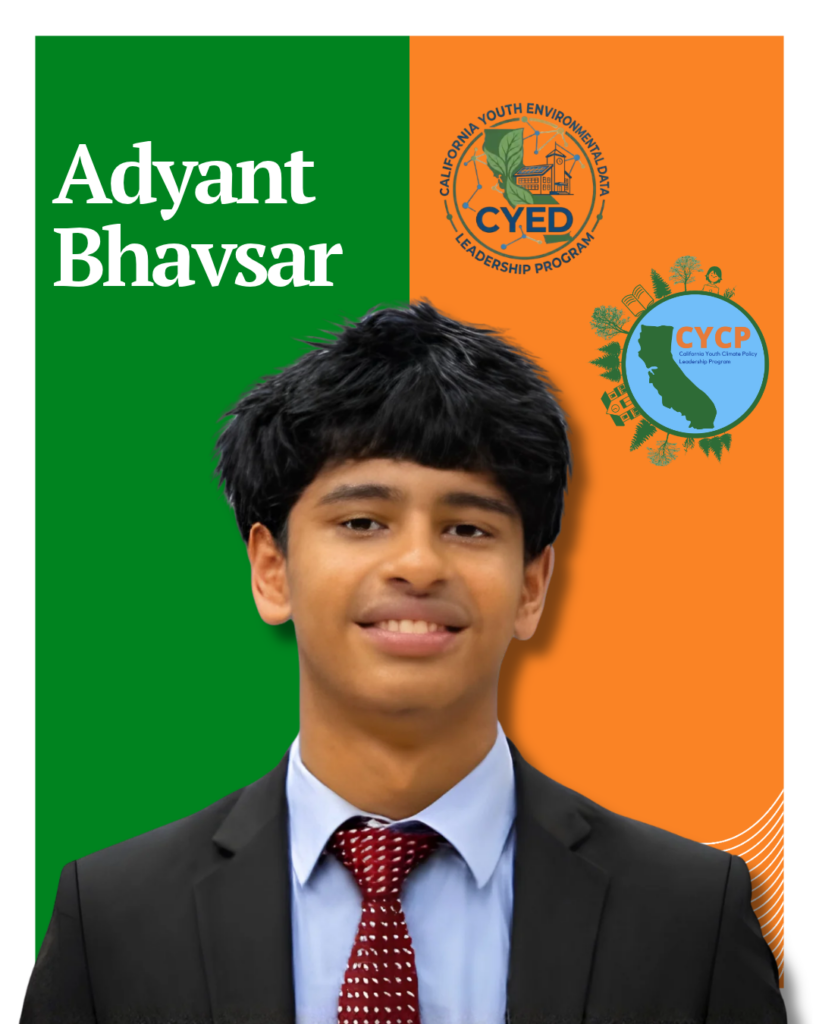
Adyant is a junior at Bellarmine College Preparatory in San Jose, and his love of science started early. As a middle schooler, he won a 2023 Lemelson Award from the Lemelson Foundation, which celebrates young inventors. Today he leads IRISTEM, a student-led nonprofit that turns scientific research into clear, accessible materials that thousands of students and teachers use for climate education and sustainability advocacy. He also does climate research with Stanford and UC Davis, carries out his own independent projects, and is nationally ranked in speech and debate. If there’s one idea that connects all of it, it’s this: Climate knowledge only matters if people can actually use it.
Starting Close to Home
Adyant’s first campaign began on his own campus. In 2024, he took a closer look at how his school handled its waste and saw room for improvement. Through the California Youth Climate Policy (CYCP) Leadership Program, he turned that observation into a student-led sustainable waste campaign.
He started with research, digging into which solutions would actually work for his school. Then he brought his classmates along. Adyant talked with students about why the issue mattered, explained what he was proposing, and gathered hundreds of signatures in support. With research and community support behind him, he presented his proposal directly to school administrators.
The experience taught him how change really happens inside an institution. Schools are balancing many priorities, and even great ideas take time, conversation, and follow-through. But Adyant also saw the power of students who organize around a clear goal and keep showing up.
Along the way, he stayed connected to the wider climate movement, sharing materials with more than 300 attendees at a climate summit in San Jose and partnering with the Make Polluters Pay campaign to create advocacy materials for their work.
For Adyant, one of the most meaningful parts of CYCP was connecting with other young leaders. “Being able to talk to other students throughout the state and understand exactly what they were doing and what problems they were encountering really opened my worldview outside of just me, my school, and those issues,” he shared. “It also just brought me a great sense of hope to see a lot of these students who had interests like I did, just letting me know that I wasn’t alone.”
Thinking Bigger
After working to change one school, Adyant started asking a much bigger question:
What would it take to expand environmental literacy across all of California?
He brought that question into the California Youth Environmental Data (CYED) Leadership Program and then into his Ten Strands Summer Internship during 2026. As an intern, he helped build the California Data Initiative for Environmental and Climate Action in California’s TK-12 Schools. California has more than 1,000 public school districts, each with its own school board and way of making decisions, and information about them was scattered and hard to use.
Working alongside fellow interns, Adyant helped organize district and school board data into one practical resource. Now, educators, advocates, and youth leaders can see how districts are structured and plan their outreach with a clearer sense of where environmental literacy efforts can take hold. The work was detailed and often slow, and it took a healthy dose of what we at Ten Strands call joyful persistence. The team also shared their findings in a poster presentation.
What It Means to Lead
Looking back, Adyant sees a common thread between his school campaign and his statewide work. In both cases, he spotted a gap, did the research, and brought people together around a practical solution. And both taught him that lasting change starts with understanding how a system works before trying to move it.
His idea of leadership has grown, too. “I’d written that a leader would be able to make the right decisions and be able to trust his gut,” he said. “But I’ve changed my definition to be able to work with a team more, to be able to understand what the collective group wants and to be able to listen to each person and understand his or her opinion.”
What’s Next
Adyant continues to bring that same approach to IRISTEM, his research, and his advocacy. Whether he’s translating a scientific study for teachers or organizing data for statewide outreach, his goal stays the same: making climate knowledge accessible so more people can act on it.
His story is a reminder that changemaking can start on a single campus and grow into something that reaches the whole state. All it takes is curiosity, careful research, and the persistence to keep building, one school and one district at a time.
Learn more about Adyant’s work at iristem.org, and watch his full changemaker interview.
Video conversation
In Adyant’s words
A conversation about the experience, the campaign and what comes next.
Download English captions (VTT)
If playback is unavailable, open the video interview with Adyant Bhavsar.
Watch the original interviewRead the full transcript
AI-assisted captions and transcript, edited for readability and automatically cross-checked against the recording. They have not been reviewed by Ten Strands. Repeated answers in the original recording are retained.
00:09 — Interviewer
Adyant, thank you so much for joining us for your Changemaker story. We’re super grateful to have you here. If you can start off with your name, the school you go to, and pronouns, and any other information you want to share.
00:23 — Adyant
Absolutely. Hi, my name is Adyant, and it’s a pleasure to be here. So thank you for having me. I’m a junior now going to Bellarmine College Prep, which is located in San Jose in the Bay Area. He, him pronouns. And I’ve been really involved in Ten Strands’ work for the past few years because I feel like it really resonates with what I’m interested in with environmental advocacy and education for communities all across California. So I was part of the CYCP cohort for the second cohort of the CYCP program. And then I returned for cohort three as a mentor where I was able to guide some amazing students towards success in their campaigns.
01:00 — Adyant
I was also part of the CYED first cohort as well as two years of student internships in which I was able to expand my love for data science as well as being able to investigate potential environmental solutions in terms of outreach efforts and navigating school districts and finding opportunities for more Ten Strands programs and outreach.
01:23 — Interviewer
Can you share with us how you heard about Ten Strands and what brought you to our programming?
01:28 — Adyant
Going into high school, I had a lot of time on my hands and I knew I always wanted to do something like tangential to environment and sustainability related, but there weren’t a lot of resources for me to get involved. And that’s where I saw the CYCP listing. And I think that was my first major introduction to Ten Strands because while I had heard the name, I hadn’t necessarily gone too into depth in the programs. And so I thought it was really cool that Ten Strands was actually having some kind of initiatives for youth because as a youth myself, I felt like there weren’t that many opportunities for me to get involved.
01:59 — Adyant
But through the CYCP program, I was able to meet some amazing people who kind of supported me throughout my journey and introduced me to Ten Strands. And then I was able to get more opportunities from there.
02:10 — Interviewer
Share with us about your CYCP policy campaign.
02:13 — Adyant
So in the CYCP program, I was essentially trying to help improve waste disposal options at my school and essentially in simple terms that’s trying to increase the amount of recycling bins that are available to students on campus and not just regular trash cans and so being able to do that was a great experience. I had to work with my school’s sustainability club which I lead, draft a resolution, get support from other students through signatures and petitions and then talk with the administration towards making that a reality.
02:44 — Interviewer
How did being part of a statewide cohort of young leaders change your perspective?
02:50 — Adyant
I remember a lot of the workshops for CYCP were kind of breakout room style, so I was able to speak with students all across California that were doing projects in kind of all ranges and sizes. So I think being able to talk to them and understand exactly what they were doing and what problems they were facing or encountering really opened my worldview outside of just me, my school, and those issues. And instead see a lot of the other good work that people are doing. And it also just brought me a great sense of hope to see a lot of these students who had interests like I did, just letting me know that I wasn’t alone in my interest for these kinds of environmental advocacy for my school.
03:28 — Interviewer
After CYCP, what led you to do this CYED leadership program?
03:33 — Adyant
I was already kind of doing an internship over that summer that involved data science. I was learning more and more how much I liked data science and how valuable that could be because it allows you to see large trends, to scope large amounts of information and data, and just in general be able to find like a bird’s eye perspective on potential solutions. And I was already kind of interested in that and that internship only like exacerbated that. But then going into the CYED program after seeing that there was something like this, I thought it was almost perfectly tailored to my interests in that way.
04:05 — Adyant
So there was almost no hesitation when I signed up.
04:08 — Interviewer
What was the process of collecting data and building your baseline report?
04:12 — Adyant
I was able to get through the large majority of it and one of the things that I had to do was actually manually collect data so that was a really fun experience being able to scour information not just for my school but also for schools kind of related like in the district that my school is located in and then just being able to scout important information like student size whether or not they have these kinds of environmental initiatives going on and it was really fun being able to kind of collect all that information in one place and then at the end find visualizations of that.
04:46 — Adyant
I was able to get through the large majority of it and one of the things that I had to do was actually manually collect data so that was a really fun experience being able to scour information not just for my school but also for schools kind of related like in the district that my school is located in and then just being able to scout important information like student size, whether or not they have these kinds of environmental initiatives going on. And it was really fun being able to kind of collect all that information in one place, and then at the end, find visualizations of that.
05:19 — Interviewer
Did your CYCP experience change the way you thought about your data processing in CYED?
05:26 — Adyant
First, going through CYCP, I was more focused on my own campaign. But going into CYED, I had the lessons from CYCP about how interesting it is to be able to observe others, help them on their campaigns, and then also receive advice because sometimes people have ideas that I wouldn’t have even thought of. So unlike CYCP, I was able to go into CYED really just being conscious from the very beginning of trying to get more diverse viewpoints, as well as being able to use other people as kind of bouncing back ideas and getting feedback for what I was planning.
05:59 — Interviewer
What did you learn from CYED that has stayed with you that you still use today?
06:04 — Adyant
What I’ve been able to do is visualization of data because it’s really helpful to be able to take big chunks of like Excel and sheets and actually make it into an appealing graph. And that’s helped me in school and other places because I’ve been able to take information for a presentation, for example, or I do speech and debate and being able to visualize data helps get my arguments across a lot smoother.
06:25 — Interviewer
Wonderful. And then after, did you want to get involved in this summer internship program?
06:32 — Adyant
For the internship because I’d seen it on the website and as a data internship obviously coming from CYED and my previous summer internship I thought that that was something I wanted to expand my skills more of so I was able to meet some amazing people on that team and be able to conduct or be part of a bigger plan and bigger operation which was to garner massive amounts of school district data that Ten Strands could use for potential outreach purposes and so that was a really fun experience because I was able to collaborate with a team and then design a poster collectively with other people that determined kind of our research findings, our visualization, and throughout it I was able to hone my skills of teamwork, data visualization, and also just staying consistent and hardworking on getting those tasks complete.
07:19 — Interviewer
Have these experiences changed the way you see yourself as a leader?
07:23 — Adyant
For the CYCP cohort and then being able to work with a team in the internship changed my definition of a leader. I remember we had this kind of exercise in the CYCP program all of those years ago. And if I’m not mistaken, I’d written that a leader would be able to make the right decisions and be able to trust his gut. But I think now I’ve changed my definition to be able to work with a team more, to be able to understand what the collective group wants, and to be able to listen to each person and understand his or her opinion.
07:53 — Adyant
And I think that’s a little bit more in a line of what I want to be as a leader as well, to be able to work with others and make sure everyone’s voices are heard.
08:01 — Interviewer
What would you say to a student who is considering joining one of our programs but are unsure?
08:08 — Adyant
Say join. I think it’s just if anyone is even remotely interested in this, I would strongly recommend it for a few reasons. But first is because you really get more experience and exposure to just in general the field of sustainability. There were some amazing talks from previous graduates, as well as the amazing people at Ten Strands and other organizations that are helping this. And I think being able to talk to them, connect with your mentor, who’s probably in this field as well, is just valuable knowledge for the future. But also, if anyone is kind of scared in terms of joining, if they feel like it might be too intimidating of a proposal, just know that you’ll have people guiding you every step of the way.
08:47 — Adyant
As a mentor, I know that I was there for my mentees. And you’ll have a mentor that’s meeting with you almost as much as you’d require, as well as experts who can help you in general to get your program or campaign running or to get you success in whatever you’re trying to do.
09:02 — Interviewer
Amazing. I’m so glad you’ve been with us. Any future plans to continue your environmental advocacy or data work in the future?
09:11 — Adyant
And what I’m trying to do more and more is get into environmental advocacy. I currently lead a nonprofit that works towards bringing environmental advocacy and empowering students to do that, as well as making materials to spread sustainability issues that teachers can use in classrooms or students can use for self-education. So I think what I’m going to try to keep doing is to work towards reducing barriers towards exposure to environmental topics, as well as advocate for environmental justice in communities that otherwise necessarily haven’t been exposed to it. In the future, I plan on looking for some kind of environmental career, whether that’s actually in environmental legislation and politics or environmental engineering, to be able to intersect my passions for data science, for coding and speaking, as well as my passion for sustainability.
10:00 — Interviewer
Amazing.
10:01 — Adyant
And what I’m trying to do more and more is get into environmental advocacy. I currently lead a non-profit that works towards bringing environmental advocacy and empowering students to do that, as well as making materials to spread sustainability issues that teachers can use in classrooms or students can use for self-education. So I think what I’m going to try to keep doing is to work towards reducing barriers towards exposure to environmental topics, as well as advocate for environmental justice in communities that otherwise necessarily haven’t been exposed to it. In the future, I plan on looking for some kind of environmental career, whether that’s actually in environmental legislation and politics or environmental engineering, to be able to intersect my passions for data science, for coding and speaking, as well as my passion for sustainability.
10:50 — Interviewer
Amazing.
10:53 — Adyant
The biggest thing that I would call it is probably perspective changing, because it really changed my perspective when it came to what being a leader is, how youth can get involved in making a difference. And it really changed a lot of what I thought I knew about how this world works and how this field works in general. I was able to meet a lot of new people that also introduced me to new ideas and experts that taught me things that I wouldn’t have even known were possible for a future in this field.
11:22 — Interviewer
Thank you so much, Adyant, for sharing your amazing journey with Ten Strands. We’re so grateful for your dedication to the program and our organization. And we’re super excited to see the impact you’ll continue to make in the future.